Vegetables
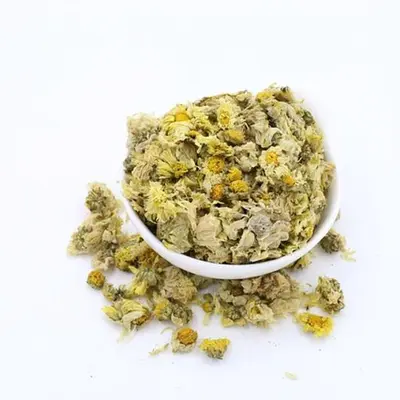
Dried chrysanthemum petals
Per 100 g
- Calories
- 283 kcal
- Protein
- 12 g
- Fiber
- 30 g
- Fat
- 0.2 g
Low fat 1% of its calories come from fat. Our scale
All nutrients
Per 100 g of dried chrysanthemum petals. % Daily Value is for an adult, US FDA values.
Macronutrients
| Nutrient | Per 100 g | % DV |
|---|---|---|
| Carbohydrates | 74 g | 27% |
| Protein | 12 g | 23% |
| Fat | 0.2 g | 0% |
| Water | 9.5 g |
Carbohydrates
| Nutrient | Per 100 g | % DV |
|---|---|---|
| Fiber | 30 g | 106% |
Fats
| Nutrient | Per 100 g | % DV |
|---|---|---|
| Cholesterol | 0 mg | 0% |
Vitamins
| Nutrient | Per 100 g | % DV |
|---|---|---|
| Vitamin A (RAE) | 15 µg | 2% |
| Vitamin C | 10 mg | 11% |
| Vitamin D | 0 µg | 0% |
| Vitamin E | 25 mg | 167% |
| Vitamin K1 | 62 µg | 52% |
| Thiamin (B1) | 0.73 mg | 61% |
| Riboflavin (B2) | 0.89 mg | 68% |
| Niacin (B3) | 3.8 mg | 24% |
| Pantothenic acid (B5) | 1.5 mg | 30% |
| Vitamin B6 | 0.69 mg | 41% |
| Folate (DFE) | 370 µg | 93% |
| Vitamin B12 | 0 µg | 0% |
Linked nutrients open a table that ranks plant foods by that nutrient.
How we label fat
Our own scale, stricter than official labels: a food with less than 10% of its calories from fat is labelled Low fat, 10% to under 20% Medium fat, 20% or more High fat. The label describes how the food's calories are made up; official US and UK labels use other limits.
More vegetables
 Endive
 Alfalfa sprouts
- Fresh wasabi root
 Alfalfa seeds, sprouted, raw
- Arrowhead, raw
 Arrowroot, raw
 Artichokes (globe or french), raw
 Arugula, raw
All vegetables · All ingredients
Source
Standard Tables of Food Composition in Japan, 8th revised edition, 2023 supplement (MEXT): Chrysanthemum, "Kikunori" (sheet of dried chrysanthemum petals) (きく 菊のり), food code 06060. Source: Standard Tables of Food Composition in Japan (Eighth Revised Edition), 2023 supplement, Ministry of Education, Culture, Sports, Science and Technology (MEXT), data updated 27 March 2026; English names from MEXT's 2015 English edition. Values edited by us (units and totals). MEXT website terms of use (Government Standard Terms of Use, compatible with CC BY 4.0). The table. Protein (nitrogen x factor), total lipid and carbohydrate by difference, as USDA measures them; sugars are the sum of the sugars in the carbohydrate tables. Daily Values: US FDA, 21 CFR 101.9.