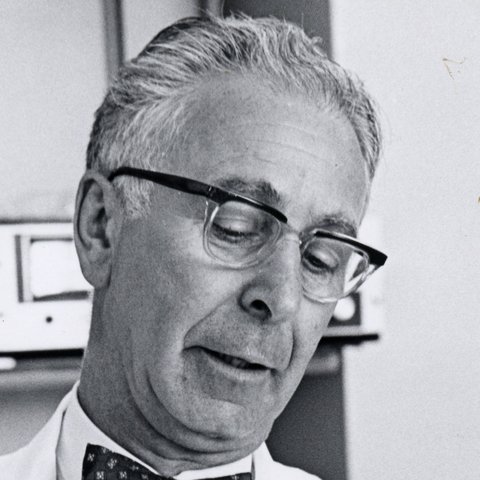
Roy Swank
MD, PhD. Neurologist who led the University of Oregon's neurology division and treated multiple sclerosis with diet (1909 to 2008).
Roy Laver Swank was an American neurologist, born in Camas, Washington, who earned his MD and PhD at Northwestern University. At the Montreal Neurological Institute from 1948 he began treating multiple sclerosis with diet, and from 1954 to 1976 he led the neurology division of the University of Oregon Medical School, now OHSU, where he kept following his patients for more than three decades. John McDougall counts him among his four mentors. He died in 2008.
Best known for
Following people with multiple sclerosis for 34 years on a diet very low in saturated fat: those who kept it under about 20 grams a day had far less disability and far fewer deaths than those who ate more.
Approach
Cut saturated animal fat hard, start as early as possible after diagnosis and keep to it for life; he saw even a few extra grams a day as enough to change the course of the disease. A historical note, kept here only: his diet was not plant based. His book's rules allowed up to 3 ounces of red meat a week after the first year, fish and white-meat poultry, dairy under 1 percent butterfat, 20 to 50 grams of vegetable oil a day, a daily teaspoon of cod-liver oil and a multivitamin; he held that oils did no harm in the disease.
Main talking points
- Multiple sclerosis was more common where people ate more fat, and rare in Japan and China.
- Patients treated early, before disability set in, had the best results.
- A large butterfat meal made red blood cells clump within hours in his laboratory studies.
What Roy says, topic by topic
Type a topic to jump to its summary on this page.
Whole grains, bread and flour
Looking back in 1997 at scurvy, beriberi from polished rice and other deficiencies that had faded into history, Swank listed the refining of grains into white flour, beside excess fat, among the nutrition problems the industrial West now faces1.
What all the experts say about whole grains, bread and flour
Low-fat eating
Swank pointed to how the disease tracked fat in whole populations. In Norway during the Second World War fat intake fell by more than half and few new cases were reported; once fat came back after the war, with extra milk added to the ration, reported cases rose sharply within two years2.
In his view doctors were trained to look for deficiencies, while the real problem in Western patients was too much: excess fat, protein and carbohydrate3. In 1997 he wrote that the nutrition problems of the industrial West now follow from excess dietary fat and the refining of grains into white flour1.
What all the experts say about low-fat eating
Saturated fat
Swank, a neurologist, began treating people with multiple sclerosis in Montreal at the end of 1948 with a diet that cut saturated fat by roughly nine tenths compared with the usual Canadian diet of the time4. He had first reported in 1950 that the disease was more frequent where people ate more fat5.
He followed 150 of those patients until 1984. Among those who kept saturated fat under about 20 grams a day, averaging 17, 31% had died by the end and most had worsened only slightly; among those who ate more, averaging 25 or 41 grams, 79% and 81% had died6. In his 1990 Lancet paper with Barbara Dugan, patients who started with little disability and kept to the limit fared best: leaving aside deaths from other illnesses, 95% were alive and still active after 34 years7.
What struck him most was how small the gap was: eating only about 8 grams a day more than the strict group was enough to bring the steep decline8. He read this as a particular sensitivity to saturated animal fat in people with the disease6, and tied it to his laboratory work of the early 1950s, where red blood cells began to stick together a few hours after a large butterfat meal and blood flow slowed or briefly stopped9.
What all the experts say about saturated fat
Each small number opens its source in a new tab: the video at the exact second, or the page where it was said. All of them are listed under References at the bottom of the page.
References
- Swank RL, A prospective discussion of past international nutrition catastrophes, Nutrition 13:344-348 (1997) ↩1 ↩2
- Swank, same talk, wartime Norway (posted 2013) ↩44:08
- Swank, same talk, excesses rather than deficiencies (posted 2013) ↩1:04:48
- Swank, talk at the McDougall Program, the diet as set up about 1949 (posted 2013) ↩2:26
- Swank RL, Multiple sclerosis; a correlation of its incidence with dietary fat, Am J Med Sci 220:421-430 (1950) ↩
- Swank RL, Multiple sclerosis: fat-oil relationship, Nutrition 7:368-376 (1991) ↩1 ↩2
- Swank RL, Dugan BB, Effect of low saturated fat diet in early and late cases of multiple sclerosis, Lancet 336:37-39 (1990) ↩
- Swank, same talk, 8 grams more a day (posted 2013) ↩8:54
- Swank, same talk, red cells after a butterfat meal (posted 2013) ↩33:48
Profile sources
- Roy Laver Swank papers, OHSU Historical Collections & Archives (Archives West)
- Swank and Dugan 1990, Lancet, low saturated fat diet in early and late cases of multiple sclerosis (PubMed)
- Swank 1991, Nutrition, Multiple sclerosis: fat-oil relationship (PubMed)
- Swank and Dugan, The Multiple Sclerosis Diet Book, chapter 11 (Google Books preview)
- Swank's talk at the McDougall Program (YouTube)
A short profile and topic summaries in our own words, for education only; it reports what Roy Swank teaches and is not medical advice. Last checked 2026-10-24. How we make this site